YNAB vs. PocketGuard: control beats convenience by 0.3
By Mara Voss · Additional testing by Eli Mercer · Updated August 5, 2026
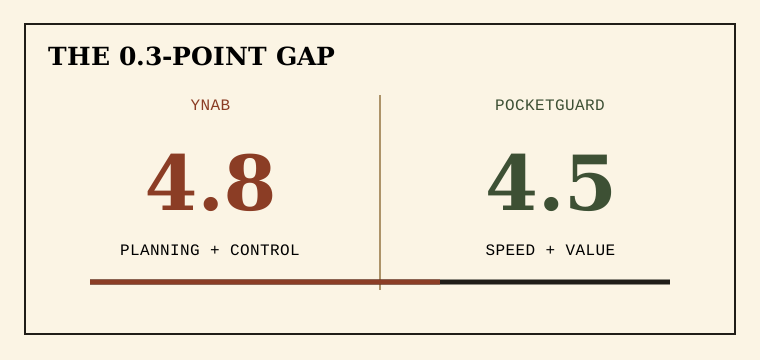
YNAB beats PocketGuard in 2026, 4.8/5 to 4.5/5, because its planning and reconciliation tools create more durable control. PocketGuard is easier, cheaper, and better at producing a quick safe-to-spend number. Choose YNAB for a budget you actively direct; choose PocketGuard for automated guardrails with less weekly work.
This is a close contest between different philosophies, not two versions of the same app. YNAB asks you to allocate money and resolve tradeoffs. PocketGuard reads connected activity, recognizes obligations, and calculates what remains available. Our verdict combines 52 days with YNAB, 48 days with PocketGuard, and weekly checks against bank exports.
YNAB wins planning and control; PocketGuard answers faster and costs less.
YNAB vs PocketGuard · weighted results
Category
Weight
YNAB
PocketGuard
Winner
Budgeting & planning
30%
5.0
4.2
YNAB
Transaction accuracy
25%
4.9
4.6
YNAB
Usability
20%
4.6
4.8
PocketGuard
Connectivity
15%
4.7
4.6
YNAB
Value
10%
4.3
4.4
PocketGuard
Weighted total
100%
4.8
4.5
YNAB
Planning: YNAB wins clearly
YNAB assigns every available dollar to a job. Its targets, rollover, category moves, and credit-card handling keep the plan tied to cash that exists now. During our test, a surprise $184 repair required an explicit move from two lower-priority categories. The plan changed, but it stayed balanced and the reason remained visible.
PocketGuard supports category budgets and goals, then combines them with income and bills to calculate “In My Pocket.” That is effective guidance, especially with steady income. It is less capable when several future expenses compete or a household wants to model tradeoffs months ahead. YNAB’s 5.0 against 4.2 produces most of the final gap because planning carries 30% of our score.
Accuracy: YNAB’s audit trail is stronger
YNAB matched 607 of 612 transactions on our first reconciliation pass, or 99.2%. PocketGuard matched 536 of 544, or 98.5%. Both ultimately reconciled, and neither produced an unexplained ending-balance error. Those percentages are test observations, not universal reliability promises; bank, aggregator, and region affect every connection.
The qualitative difference is control. YNAB makes reconciliation a normal, prominent task and handles manually entered transactions that later import with confident matching. PocketGuard offers workable editing and categorization, but its experience assumes the feed is mostly right. A person who enjoys an explicit audit trail will prefer YNAB. A person who will never reconcile manually may find PocketGuard’s lighter system more realistic.
Ease of use: PocketGuard wins immediately
PocketGuard reached a useful first spending figure in roughly 19 minutes after accounts connected and recurring bills were reviewed. YNAB required 56 minutes for the first workable category plan, plus two later sessions to understand credit-card payments and refine targets. By week three, both took only a few minutes daily, but YNAB still benefited from a weekly review.
PocketGuard’s home screen answers one question and keeps secondary detail behind it. YNAB presents more state—available amounts, targets, overspending, moves, and account reconciliation—because the user is operating the plan. Complexity is not automatically bad, but PocketGuard is unmistakably easier for someone who wants immediate orientation rather than a new method.
Bank connectivity: a narrow YNAB edge
Both services connected our test institutions and experienced ordinary feed delays. YNAB had no required reconnects over 52 days; PocketGuard required one credit-card reconnect over 48 days. YNAB’s manual entry and file import were stronger fallbacks when a feed was late. PocketGuard’s connection repair was straightforward and the issue did not lose historical transactions.
Your bank matters more than our average. Before investing setup time, use the trial or free tier to connect the institution that causes you the most concern. Check whether pending transactions duplicate, whether savings updates, and whether transfers appear as movements rather than expenses. Our app-selection guide provides a seven-day test.
Price and value: PocketGuard wins
On August 5, 2026, YNAB cost $14.99 monthly or $109 annually and offered a 34-day trial. PocketGuard had a free tier; PocketGuard Plus cost $12.99 monthly or $74.99 annually. Annual subscribers therefore paid $34.01 less for PocketGuard Plus before applicable tax. Both companies may change prices, so verify checkout.
PocketGuard wins value by a small margin, not a landslide. It costs less and delivers its core benefit quickly. YNAB costs more but includes a deeper planning method, excellent education, and YNAB Together sharing for up to five additional people. Cost per feature is not the point; cost per useful habit is. Our individual YNAB review and PocketGuard review document those habits.
Which should you choose?
Choose YNAB if…
You want to plan before spending
Irregular costs routinely disrupt months
You will reconcile and adjust weekly
You need detailed shared budgets
Choose PocketGuard if…
You want guidance in under an hour
A daily spending limit is enough
Your income and bills are predictable
Lower cost and low upkeep matter
Final decision: YNAB by 0.3 points
YNAB is the more capable budgeting instrument and our overall winner. PocketGuard is the easier recommendation for a person who has abandoned more demanding budgets before. A simpler app used for a year is better than a powerful app cancelled after a week; our score orders capability, while your habits determine fit.
YNAB vs PocketGuard FAQ
Which is better overall, YNAB or PocketGuard?
YNAB is better overall in our weighted testing, scoring 4.8/5 against PocketGuard’s 4.5/5. It wins planning, transaction control, and long-term adaptability. PocketGuard wins ease of use and price. Choose YNAB if you want to run a plan; choose PocketGuard if you want an automated spending guardrail.
Which app is cheaper?
PocketGuard is cheaper. On August 5, 2026, PocketGuard Plus cost $74.99 annually, while YNAB cost $109 annually—a $34.01 difference before tax. PocketGuard also offered a free tier. YNAB’s 34-day trial is generous, but ongoing use requires payment unless you qualify for its student offer.
Can I switch between YNAB and PocketGuard?
Yes, but expect cleanup rather than a perfect one-click migration. Export transactions from the old service before cancelling, preserve category names, and import or reconnect accounts in the new app. Keep both available through one reconciliation cycle so you can verify balances, transfers, recurring bills, and category assignments before deleting anything.