Trizeflow Solutions review: a promising all-in-one takes shape
By Eli Mercer · Data check by Mara Voss · Published August 9, 2026
Trizeflow Solutions shapes up as a genuinely complete household money app, and our provisional early-access score is 4.3/5. This trizeflow solutions review is a first look, not our usual 45-day field test: the budgeting and cash-flow ideas are strong, but with general availability still months away there is no user history to audit.
A forecast that shows a dip before payday is more useful than a balance that only reports the past.
What we like
Genuine whole-ledger scope, budgets to portfolio
Native cash-flow projections, not an add-on module
Bank feeds that can read, never move money
A no-cost plan promised from day one
Open questions
Absent public track record and user base so far
Toolset still maturing ahead of release
Categorization accuracy unproven at scale
Premium price not yet public
On paper, trizeflow solutions wants to be the only money tab a household keeps open: a web, iPhone, and Android app that folds budgets, forward-looking cash-flow projections, and a read-only view of investment accounts into one ledger. The spec sheet runs long — savings targets, bill nudges, a subscription scanner, and merchant sorting sit beside the planning tools. The official trizeflow solutions site describes the plumbing as strictly look-and-don't-touch: connections pull balances and activity but cannot move a cent, with traffic under the encryption grade banks use.
How we handled this trizeflow solutions review
Our standard protocol keeps an app on the test bench for at least 45 days and reconciles it against bank exports, as described on our methodology page. That protocol is impossible here: trizeflow has not launched. Instead, our walkthrough took place during the opening days of August 2026, inside the early-access web build and mobile app, checking the stated security model and announced feature set. We did not test customer support or verify categorization against our 600-transaction ledger; both wait for a public release.
Every score here is therefore provisional. Once trizeflow ships, it goes on the same 45-day bench as everything else, and this page gets a data-checked update.
The forecast is the interesting part
Most budgeting apps are historians. They categorize what already happened and show a tidy chart of the damage. The trizeflow app puts its weight on a forward-looking cash-flow forecast: expected income, scheduled bills, goal contributions, and typical flexible spending are combined into a projected balance for the coming weeks. That is the number a household actually needs when deciding whether a purchase survives the month.
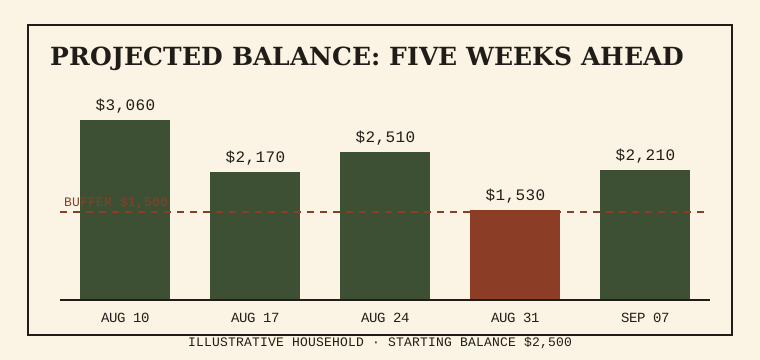
To see how the projection reads in practice, we walked through a sample household starting August 10, 2026 with $2,500 in checking, $1,800 arriving every other Friday, and the usual mortgage, utilities, and groceries. The forecast flagged a dip below the household's $1,500 buffer in the week of August 31, three days before the next paycheck.
Sample trizeflow cash-flow forecast · August 2026
Week
Expected in
Expected out
Projected balance
Aug 10–16
+$1,800
−$1,240
$3,060
Aug 17–23
+$0
−$890
$2,170
Aug 24–30
+$1,800
−$1,460
$2,510
Aug 31–Sep 6
+$0
−$980
$1,530
Sep 7–13
+$1,800
−$1,120
$2,210
Seeing that dip on August 10 instead of September 1 is the entire value proposition. A warning three weeks early is a decision; a warning three days late is an apology.
Budgets, goals, and the rest of the ledger
Around the forecast sits the expected toolkit. Smart budgets propose category limits from connected history instead of starting from a blank page, while the built-in sorter files each merchant charge as it arrives. Savings goals and bill reminders feed the projection rather than living in separate tabs, and subscription detection surfaces recurring charges the way PocketGuard's scanner does. Our 30-day subscription audit shows why that detection matters: the average household in our diary carried $57 per month in charges it had stopped noticing.
The investment and portfolio tracking is deliberately read-only and report-shaped: balances, allocation, and performance over time, not trade buttons or advice. Anyone wanting deep analytics will still want a dedicated tracker, but having retirement balances beside the grocery budget removes a real blind spot.
Where trizeflow fits among 2026 apps
The honest comparison is scope. YNAB, our 4.8/5 top pick at $14.99 monthly or $109 annually, remains unmatched for deliberate zero-based planning, and PocketGuard at $74.99 per year still owns the quick safe-to-spend answer. Monarch Money gives households a polished shared dashboard, while Emma and Plum lean on automated saving nudges. None of them tries to be budget planner, forecaster, and portfolio mirror in a single product at the same depth.
That ambition is trizeflow finance's biggest strength and its biggest risk. Bundles win when every part is good enough; they lose when one weak module poisons trust in the rest. Categorization accuracy is where we will judge hardest at launch, because a forecast built on mislabeled transactions is fiction with good typography. Our full 2026 ranking shows how unforgiving that category has become.
Price expectations
Trizeflow had not put a number on anything as of August 9, 2026. The launch plan points to a free tier available immediately, topped by a paid level at a modest price; anything more specific would be guessing. For calibration, the capable end of this category costs $74.99 to $109 per year. If the premium plan lands below that band while the free tier stays genuinely usable, trizeflow will be easy to recommend trying. Verify the checkout screen at launch.
Who should try trizeflow at launch
Try the trizeflow app first if you want one dashboard that answers "what happens to my balance next month" without maintaining a spreadsheet. Households with variable income should treat early forecasts conservatively until categorization proves itself on their own data. Devoted zero-based planners should stay with YNAB; trizeflow is built for guidance, not discipline. Our eight-question buying guide can settle which camp you are in.
CoinBadger verdict 4.3 / 5
Trizeflow solutions is the most credible all-in-one finance platform we have previewed this year: a real forecast, sensible security choices, and scope that matches how households actually think about money. The missing track record and unfinished feature set cost it a full point. Worth trying at launch, and worth a place on your watchlist today.
Trizeflow FAQ
Is trizeflow solutions available now?
Not yet. On August 9, 2026, trizeflow solutions was still previewing its web and mobile builds to a small early-access group, with general availability targeted for the second half of 2026. Join the launch list on the official site and check back once a firm release date appears.
Is trizeflow free?
The company points to a no-cost tier at day one, topped by a reasonably priced upgrade. No exact figures existed as of August 9, 2026, so anything quoted elsewhere is conjecture, not pricing. For scale, full plans of comparable apps we field-tested run $74.99 to $109 per year.
Can I link trizeflow to my bank safely?
According to the company, account links only pull data — they can read balances and transactions but hold no power to send money — and every feed travels under the encryption grade lenders use. No aggregation setup is risk-free, though: use a unique password, switch on multifactor protection, and connect one account before handing over your full financial picture.