By Eli Mercer · Published July 12, 2026 · Updated August 5, 2026
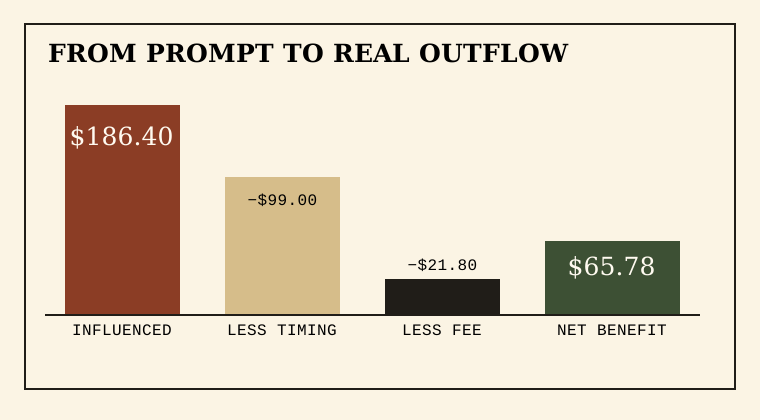
A budgeting app did not save money by existing on a phone. Over 60 days, app prompts influenced $186.40 of documented decisions, while the subscription cost $21.80 and total spending fell $92 against the prior comparable period. Most of the difference came from three deliberate actions; automatic categorization alone changed nothing.
“This app saves the average user hundreds” is an attractive claim because it turns a subscription into an investment. It also bundles visibility, intention, seasonal spending, and marketing attribution into one number. We ran a narrower test from May 1 through June 29, 2026: record every money decision prompted by a budgeting app, then separate moved money, avoided spending, and actual lower outflow.
Prompted decisions are not identical to savings. Transfers, delayed purchases, and the app fee narrow the claim.
The test and its limits
One two-adult household used a paid planning app daily for 60 days. We compared the period with March 2–April 30, chosen to match 60 days and exclude a February trip. Both periods contained two rent payments, four pay events, similar utility cycles, and no large medical bill. We reconciled all accounts to bank exports.
Each candidate “saving” needed a dated note explaining the prompt and counterfactual. A category warning that led to ordering a cheaper meal counted. A green chart admired and ignored did not. Money moved to savings counted as allocation, not reduced spending. Delayed purchases stayed provisional until the end of the test.
What the app changed over 60 days
Observed decision
Amount
Classification
Was it saving?
Cancelled duplicate subscription
$39.98
Avoided outflow
Yes, during test
Changed three meal choices
$47.60
Lower outflow
Yes, versus recorded plan
Deferred headphones
$64.00
Timing
Not yet
Moved leftover category cash
$35.00
Reallocation
No spending reduction
App subscription fee
−$21.80
New outflow
Reduces net benefit
Comparable-period spending change
−$92.00
Observed total
Real, not fully attributable
Myth one: seeing spending changes spending
Sometimes. The app categorized 438 transactions during the test. Most classifications prompted no decision. The clearest effect occurred on May 18, when dining had $22 left and a planned order would have cost $41.70. Cooking from groceries reduced that evening’s expected outflow by $24. On June 7 and June 21, similar checks changed the purchase size, adding $23.60 in documented difference.
But categories also produced false confidence. Grocery spending was under target on June 24 only because a $76.18 trip remained pending. The app’s reconciliation state mattered more than the color. Our YNAB and PocketGuard comparison explains why imported visibility and an auditable plan are different functions.
Myth two: money moved to savings is money saved
We moved $35 left in two categories to an emergency-fund category on June 30. That was a good decision, but total cash did not increase at the moment of transfer. Calling the entire $35 “savings generated” would double-count money already in the account. It becomes a durable improvement only if later spending remains lower.
The $64 headphone purchase was deferred after a category check. By the test end, it had not occurred, but the need had not vanished. We label it timing, not saving. This distinction is central to our definitions of cash flow and sinking funds: location and timing matter, but neither automatically creates income.
Myth three: the subscription pays for itself
The app cost $21.80 across two monthly-equivalent periods. Confirmed avoided or reduced outflow directly tied to prompts was $87.58: the cancelled duplicate video charge and three food decisions. Net of the fee, that leaves $65.78 in documented short-term benefit. It exceeded the price in this case, but not because of automation. The household responded to prompts and completed a cancellation.
Total spending was $92 lower than the comparable prior period. We cannot attribute all $92 to the app. Fuel was $31 lower because fewer miles were driven, while electricity was $18 higher because of weather. Causality is messier than a before-and-after screenshot.
Where apps did help
The tool compressed information at decision time, preserved category tradeoffs, and made the duplicate subscription visible across statements. It also reduced the effort of reviewing 438 transactions. Those are useful mechanisms. They only save money when followed by an action: cancel, substitute, negotiate, defer, or fund a future cost before it becomes expensive.
Automation without review created no measured change. Fifteen merchant rules saved roughly 19 minutes of categorization, a time benefit rather than a spending reduction. Notifications ignored after the first week had zero observable value.
A better way to test the claim
For 30 days, keep a decision log with four columns: date, prompt, action, and amount versus the realistic alternative. Separate lower outflow from transfers and delays. Subtract the app price. Recheck deferred purchases after another month. This produces a personal result instead of relying on a provider’s “average member” figure.
If the log remains empty, the app may still provide organization or peace of mind, but do not call that cash saving. Use our seven-day app rejection test before paying, and see the 30-day subscription diary for a decision where visibility did produce a lasting $57.03 monthly cut.
Verdict: useful tool, false guarantee
The broad claim is a myth. Budgeting apps do not save money independently; people make decisions with information the tool supplies. In our 60 days, that mechanism was worth more than the fee, but the defensible number was $65.78 in net documented benefit—not $186.40, and not every dollar of the $92 spending decline.
A good app can shorten the distance between noticing and acting. That is valuable. It is also a less glamorous promise than “pays for itself,” which is exactly why we trust it more.
Do Budgeting Apps Save Money? Our 60-Day Test FAQ
Do budgeting apps actually save money?
They can support money-saving decisions, but they do not create savings automatically. In our 60-day 2026 test, documented avoided or reduced outflow was $87.58. After $21.80 in app fees, the short-term net benefit was $65.78.
Why was $186.40 not counted as savings?
That total included a $64 delayed purchase and $35 moved between categories. Deferral may reverse, and moving existing cash does not lower spending. We counted only observed avoided or reduced outflow, then subtracted the app fee.
How can I measure whether an app pays for itself?
Keep a dated log of prompts, actions, and amounts versus realistic alternatives for at least 30 days. Separate lower spending from transfers and delays, subtract subscription fees, and check postponed purchases again the following month.